

DOGE Results
When Smart People Fail Miserably

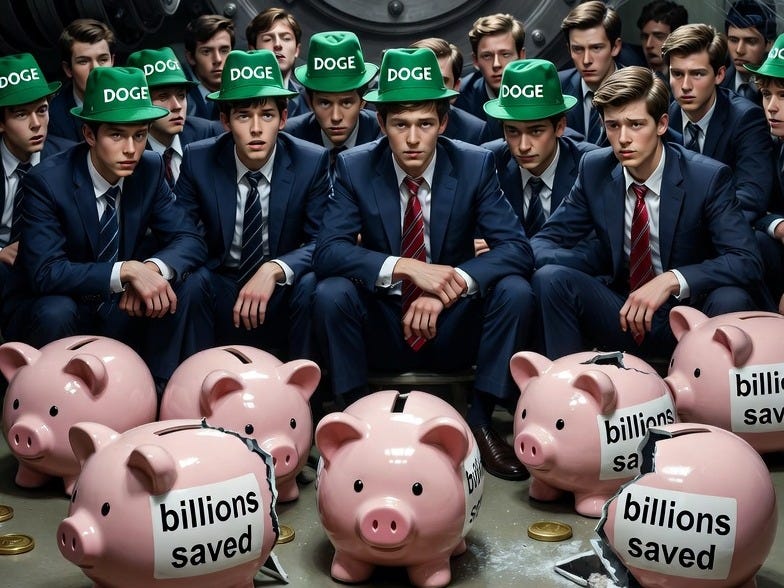
The recently released DOGE staff disposition videos triggered two immediate thoughts - first, arrogance, youth, and AI competence can be a dangerous combination, and second, young men are spending too much time on their hair.

In the heady days following Donald Trump’s 2024 election victory, mostly conservatives across America harbored high hopes for a radical overhaul of the federal bureaucracy. The announcement of the Department of Government Efficiency—affectionately dubbed DOGE, in a nod to Elon Musk’s cryptocurrency predilections—promised a dream: slashing trillions in wasteful spending, dismantling entrenched regulations, and restoring fiscal discipline to a bloated Washington apparatus. Led by Musk and entrepreneur Vivek Ramaswamy, DOGE was positioned as the “Manhattan Project of our time,” a bold initiative to deliver a “smaller government” as a bicentennial gift to the nation by July 4, 2026. In my time as a political appointee in Washington, DC I saw the bloat and bureaucratic arrogance first hand. USAID was the worst. I was initially excited about the objectives and goals of DOGE.
Yet, as we reflect in early 2026, with DOGE unceremoniously disbanded in November 2025—eight months ahead of schedule—the reality has proven far more sobering. DOGE’s collapse underscores the perils of outsourcing governance to celebrity entrepreneurs, the intransigence of congressional politics, and the enduring challenges of taming a federal leviathan that defies easy fixes.
DOGE’s origins trace back to the 2024 campaign trail, where Trump, Musk, and Ramaswamy wove a narrative of transformative efficiency. Musk, fresh from his acquisition and restructuring of X (formerly Twitter), pledged to apply private-sector ingenuity to government waste. In public statements, he vowed to cut $2 trillion from the annual $6.5 trillion federal budget—a figure representing nearly a third of total spending. Ramaswamy, the biotech entrepreneur and former presidential hopeful, echoed this ambition, advocating for a 75% reduction in the federal workforce and the outright elimination of agencies such as the Consumer Financial Protection Bureau (CFPB). Trump himself framed DOGE as a crusade against “massive waste and fraud,” promising to “liberate our economy” and make government accountable to “We the People.”
For decades, Republicans have decried the growth of entitlement programs, regulatory overreach, and bureaucratic inertia. DOGE’s objectives aligned neatly with this worldview: dismantle bureaucracy, slash regulations, cut expenditures, and restructure agencies. Specific targets included pausing payments on unauthorized programs, firing non-essential personnel, and leveraging executive orders to bypass congressional gridlock. Musk’s vision extended to symbolic gestures, such as a “wall of receipts” website cataloging savings, which initially claimed $160 billion in cuts but was later plagued by errors and revisions. Ramaswamy, before stepping down in early 2025 to mostly pursue a Senate bid, emphasized eliminating programs with “expired authorizations,” framing it as a straightforward purge of outdated spending.
They evoked the spirit of Ronald Reagan’s Grace Commission, which in the 1980s identified billions in potential savings through efficiency reforms. Yet, unlike Reagan’s effort, which relied on legislative buy-in, DOGE was conceived as an advisory body outside traditional government structures—created via executive order on January 20, 2025. This structure, while innovative, sowed the seeds of its undoing, as it underestimated the constitutional constraints on executive power.
Key objectives included:
Budgetary Cuts: Targeting $2 trillion in annual reductions, equivalent to eliminating entire departments. Proposals floated during the campaign included shuttering the Department of Education and slashing funding for international aid programs deemed wasteful.
Workforce Reduction: A 75% cut to the federal civilian workforce of approximately 2.2 million, focusing on “non-essential” roles. Musk publicly mused about firing 90-95% of employees, drawing parallels to his layoffs at X.
Regulatory Rollback: Eliminating “excess regulations” that stifle business innovation. This aligned with conservative critiques of agencies like the Environmental Protection Agency (EPA) and Securities and Exchange Commission (SEC), which were accused of overreach.
Structural Reforms: Restructuring agencies to enhance efficiency, including merging duplicative functions and leveraging technology for automation. Musk advocated for AI-driven audits to identify fraud, promising a tech-savvy approach to governance.
Timeline and Accountability: Operations were to conclude by mid-2026, with regular public updates via social media and the DOGE website. This transparency was touted as a departure from opaque Washington practices.
These goals were not without precedent. Think tanks like the Heritage Foundation and Cato Institute have long advocated similar reforms, arguing that federal spending’s trajectory—projected to hit 24% of GDP by 2030—threatens economic liberty. DOGE’s leaders positioned it as a fulfillment of Project 2025’s agenda, blending deregulation with cultural conservatism by targeting programs associated with diversity, equity, and inclusion (DEI).
DOGE’s rollout began with fanfare in January 2025, as Musk and Ramaswamy embedded teams in federal agencies to hunt for inefficiencies. Early actions included executive orders ending DEI programs and canceling contracts with language referencing equity initiatives. By February, the “wall of receipts” boasted $16.8 billion in savings, halved after a glaring error involving a misreported USAID award. Musk’s tenure, however, was short-lived; he stepped back in May 2025 amid conflicts with his corporate empire, leaving a vacuum.
What followed was a cascade of failures. DOGE’s total savings tallied around $214 billion by disbandment—impressive in isolation but a mere 10% of the $2 trillion target. Many claims were inflated or erroneous; for instance, the website’s $160 billion figure included double-counted items and symbolic cancellations that courts later reinstated. Workforce reductions stalled at modest levels, with mass firings sparking lawsuits under the Civil Service Reform Act and union backlash.
Politically, DOGE hit a wall on Capitol Hill. Despite Republican majorities, lawmakers balked at deep cuts affecting their districts. Conservative senators like Thom Tillis expressed frustration, calling Musk a “great catalyst” but lamenting the “missteps and inefficiency.” Efforts to impound funds echoed Nixon’s failed attempts, violating the 1974 Impoundment Control Act. By mid-2025, DOGE’s initiatives were mired in legal challenges.
Public opinion soured quickly. Polls showed 58% disapproval of Musk’s role, with even 39% of Republicans concerned about haphazard implementation. Americans agreed on inefficiency as a problem but opposed cuts to popular programs like Social Security. DOGE’s focus on culture-war targets—DEI grants and minor contracts—drew accusations of prioritizing symbolism over substantive deficit reduction.
DOGE’s demise is a cautionary tale of hubris. The initiative’s reliance on executive fiat ignored the Constitution’s separation of powers; Congress’s “power of the purse” rendered many proposals dead on arrival. Musk’s business acumen proved ill-suited to government’s deliberative nature. Implementation flaws compounded the issue: chaotic rollouts, errors in savings tallies, and a failure to build coalitions. DOGE exposed the tension between ideals of limited government and the political reality of entrenched interests. Even supportive voices, like those at the Cato Institute, noted that cuts were “nothing” relative to the deficit. The initiative’s disbandment in November 2025, amid White House shifts to other priorities, marked its quiet burial. The episode reaffirms the need for disciplined, incremental reforms rather than grandiose promises with participants with zero skin in the game.